Landscaping Lawn Care Books CleanupFor Texas owners
The Margaret Hunt Hill Bridge marks the page. The practice is in Dallas. Texas lawn owners sit with us on one screen, and past Dallas and Fort Worth we are all Texans.
Name the Texas bid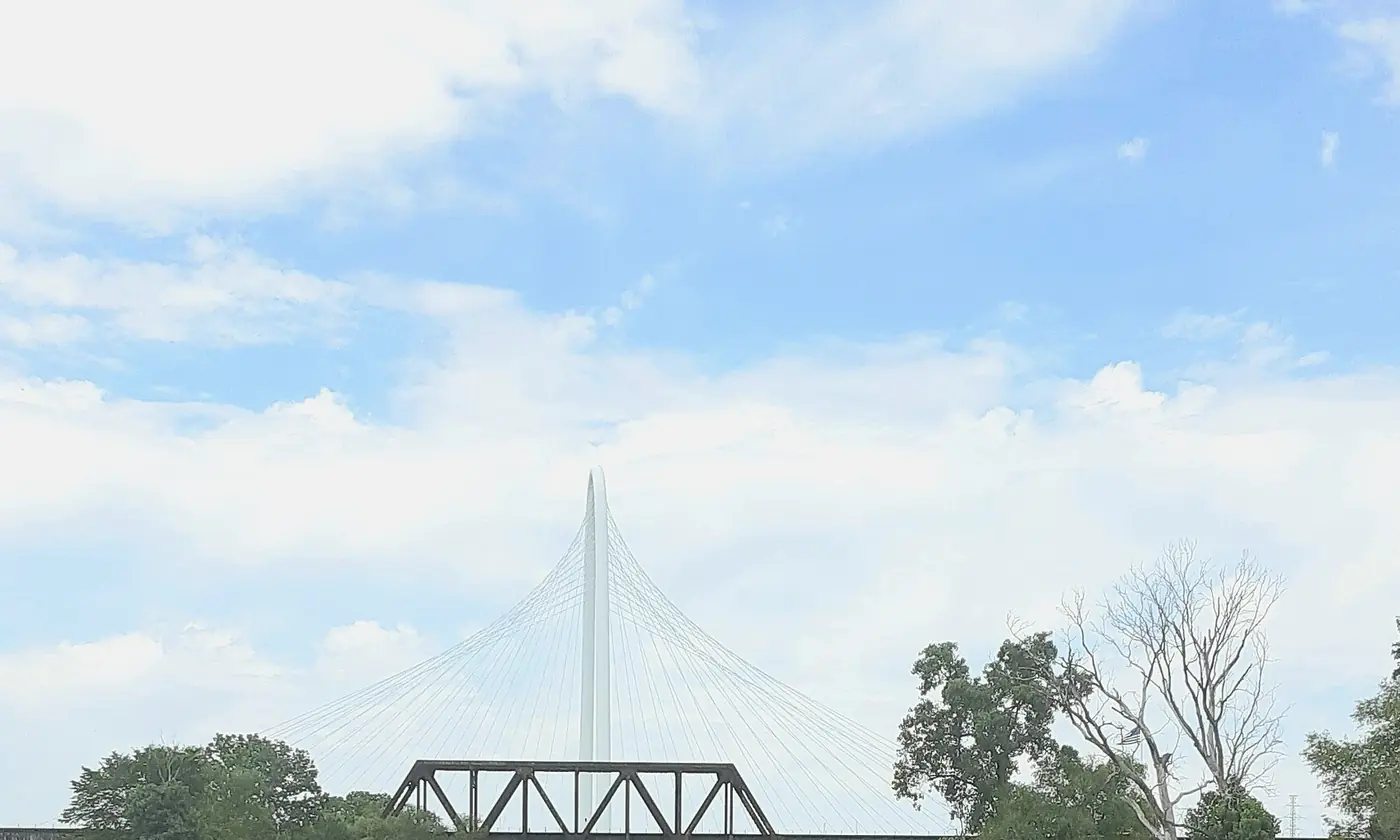
One close date, wherever the route is
The practice is in Dallas and works with Texas lawn owners by video, shared books, and one calendar. A route in Plano and a route past Lubbock close on the date we wrote down, because that date does not slide with the highway. A crew in El Paso, a crew in the Valley, and a stop the weather map skips all share that same close date. Anyone whose route sits outside those two cities is still in this conversation. We are all Texans. We do not claim a truck in your county. We claim the screen and the date.
July and August in Dallas run hot, with days over 100, and we feel that stretch too. The books should not wait until the grass slows down. A hot week can look like profit for a reason nobody can point at. The close is how that week gets a number.
Places we like, and the line each one asks for
Northeast Dallas holds White Rock Lake, the reservoir made when White Rock Creek was dammed. That long loop of water is one we like. A route around it still needs each service on its own line. Fall at the Dallas Arboretum brings the Pumpkin Village, and we enjoy that lawn walk with everyone else who came. A design fee buried in a mowing bid still needs its own line. Dallas points people onto the Katy Trail, and Knox is a real crossing on it. We like a path with a sequence. An invoice, pipe included, should read in a sequence too.
Woodall Rodgers crosses the Trinity into West Dallas on the Margaret Hunt Hill Bridge, the white arch Santiago Calatrava drew, open since 2012. People look up. We look up too, and then we think of a sprinkler trench, because a price that forgets the pipe is like a map that forgets the river under that arch. Uptown still has its little streetcar on McKinney Avenue, restored, running daily, Arts District at one end and West Village at the other. We like a ride that knows its stops. A question about a bid should be that easy to board.
The Dallas Marathon, the oldest marathon in Texas, is usually run in December. It starts and finishes downtown and loops White Rock Lake on the way. We like that it has a finish you can point at. A seasonal price that loops design, mowing, and a sprinkler into one number is the bid we would rather see split before December closes the year. Big Tex has stood in the middle of Fair Park since 1952, fifty five feet tall, and people have used that figure as the meeting spot at the State Fair ever since. We like a meeting spot you cannot miss. Ours is a video call with the bid open. The fair can keep the tall figure.
At the foot of the Hunt Hill arch, La Bajada has Trinity Groves, the restaurant yard people reach after they have already crossed the Trinity. We like that order. The call still opens on the line the seasonal price was hiding. Spring in Dallas is the week a cool front out of Canada meets humid air off the Gulf, and the hail that comes with that clash can shred a bed the crew finished a few days earlier. We feel that weather too. A repair after hail is still its own line.
The tank, the decal, and the department
Anyone who puts a pesticide on a lawn, a tree, or a weed bed and gets paid for it in Texas needs a license from the Texas Department of Agriculture. A product labeled for general use is included in that duty. Fertilizer by itself is not that duty. If the only thing in the tank is fertilizer, this license is not the fact the month is waiting on.
Landscape maintenance sits in category 3A, and the business registers with the department as well as the person who does the work. A commercial applicator license is 200 dollars a year. Each category exam is 64 dollars, and sitting the exam again after a miss is another 64 dollars. The person passes the general standards exam and at least one category exam before the truck goes out as a for hire application.
The business shows financial responsibility of 100,000 dollars for property damage and 100,000 dollars for bodily injury for each occurrence. It also keeps at least one person who holds the commercial applicator license. Each vehicle used for category 3A work carries the department's vehicle decal. We leave regional office numbers off this page so nobody dials them thinking they have reached us. This practice does not hold an applicator license. If your crew applies product for hire, say so. If the crew only mows, say that.
Publication 94-112 and the five percent line
Some lawn work can stay off the sales tax, and only when the invoice lets a reader see it alone. Mowing a pipeline or a highway right of way can stay quiet. So can trees cut back from a power line, a mow on farm or forest land, and a cemetery. The quiet is not a feeling. It is a line. Pour those jobs into a bill whose taxable share is over five percent and Comptroller publication 94-112 treats the whole bill as taxable. That presumption is the default the return has to beat.
A conversation about the yard, the research behind a plan, and the plan itself are landscape design. When that fee is stated apart from the mow, the planting, and the rest of the taxable list, the fee stays off those taxable services. Fold the design fee into a mixed total whose taxable share is over five percent and the total is presumed taxable, design and all. You can still sell the season as one conversation. The invoice has to point.
There is a narrow quiet for a person who does the lawn work personally, has no employees and no partners doing that work, and has five thousand dollars or less of gross receipts from the services across the most recent four calendar quarters. That person does not collect sales tax on lawn care and landscaping. Pest control that needs a license sits outside the quiet. Collection starts on the first day of the quarter after the five thousand dollar line is crossed. It stops in the quarter after receipts fall back to five thousand dollars or less. The test looks backward at four quarters, so a slow winter does not erase a loud spring by itself.
The week a solo operator hires the first employee, the five thousand dollar quiet stops. The exception needs the person to do the work and to have no employees or partners doing it. A spouse who mows on Saturdays, a partner who runs the routes, or a friend you pay in cash can end the quiet even earlier. Ordinary collection then starts on the schedule in the publication. It does not wait for you to feel like an employer.
Payday, the wage floor, and the benefit range
The wage floor Texas follows for a nonexempt employee is the federal 7.25 dollars an hour. After 40 hours in a workweek, overtime is generally one and a half times the regular rate. Payday law asks that nonexempt employees be paid at least twice a month. A day rate or a job rate survives only when the hours worked still clear that floor. The payroll account for this crew is set up on a provider you already operate. We do not run payday.
For a benefit year that starts on 5 October 2025, weekly unemployment benefits run from 75 dollars to 605 dollars. The weekly figure is the high quarter of base period wages divided by 25, then rounded to the nearest dollar, and it stays inside that range. We do not quote a crew member's benefit on this page. We do want the books able to show the wages that would feed that math if a letter ever asked.
What can move on a certificate, and what stays in the trailer
On taxable landscaping, a resale certificate can cover what you buy and then transfer to the customer. Think of the plants that leave in the ground, the processed soil that goes with them, the fertilizer and the herbicide that stay on that yard, and the edging that becomes part of the bed. The mower, the trimmer, the wheelbarrow, the gloves, and the rest of the tools stay yours. Those purchases are taxable. No exemption turns a trailer full of equipment into a resale.
When someone else does part of a taxable job, the prime gives that party a resale certificate and collects tax from the customer on the full charge. If you are the subcontractor, the certificate you accept is the reason you do not collect, and the reason your invoice has to match the scope the certificate named. A lump sum construction contract is one price. Under a lump sum, tax is paid when the materials are bought, and the customer is not charged tax again. A separated contract states labor and materials apart, buys the materials with a resale certificate, and collects tax on the materials. A lawn bid that feels like one price is not automatically the lump sum kind.
The irrigator license and the trench
A landscape irrigator license from the Texas Commission on Environmental Quality is what you need to sell, design, install, maintain, alter, repair, or connect an irrigation system, including the connection to a water supply. Advertising irrigation without that license is unlawful, and the ad has to show the license number. The fee is 111 dollars. Each section of the exam needs a score of at least 70 percent. Renewal for an irrigator takes 24 hours of continuing education.
Putting an underground sprinkler in the ground is missing from the landscaping list, so the construction tax rules are the ones that apply. The same installation is still irrigation work that needs the license. Both facts can be true on one job. Work done inside a plumbing license can sit outside the irrigator license. A professional engineer, an architect, or a landscape architect working inside that profession can sit outside it as well. We do not stretch those exceptions to cover a mowing crew that also trenches.
The May report and the sales tax rate
The franchise report for 2026 uses 2,650,000 dollars as the line under which no franchise tax is due. An information report is still required at or under that line. May 15 is the due date. A lawn company that sells services is charged 0.75 percent unless it meets the retailer or wholesaler test, and meeting that test moves the rate to 0.375 percent. We would rather pick the rate while the year is still in view than discover it on the week the report is due.
On a taxable mow or a planting, the state rate is 6.25 percent and local additions can reach 2 percent. The base is the whole charge unless a nontaxable piece was truly split off. Once tax paid in the prior year reaches 50,000 dollars, the sales tax return leaves paper. Webfile remains available. A seasonal contract can still be split in October, while the year is open.
Texas counts six real property services. Landscaping and lawn maintenance are two of them. Garbage removal, janitorial and custodial work, structural pest control, and surveying are the other four. Buy those services for a residence that is still being built for the first time and sales tax stays off that purchase. A repair or a remodel of an older house does not get the same quiet. What the file keeps is a signed statement from the builder. We do not treat a verbal note as that statement.
If the Comptroller calls you in, that room stays with someone allowed to speak there. We stay with the invoices and the answers the letter listed. Owners who want the statute can read Occupations Code 901.451 beside 901.453 and 901.456 on the capitol site. Those sections are the fence. Signing an examined report is not a job this lawn practice takes, and neither is signing a review or a compilation.
Texas Department of Agriculture, category 3A. Comptroller publication 94-112. Franchise tax instructions for the 2026 report. Texas Workforce Commission wage and unemployment pages. Texas Commission on Environmental Quality, irrigator license.
 You will be talking to the Steven Palmieri practice.
Name the Texas bid
Say whether the crew sprays for hire, trenches, or is still one person on the tools.